

It might seem that carrying a child older than 1-3 years is unnecessary, that the child does not need it, that they already walk on their own, that we are spoiling them for no reason, and so on. None of that is true. Why and in which situations is it great to carry even bigger children?
Ways to carry children
Carrying means any way in which the child does not walk on their own and someone carries them. This can be in your arms, on your shoulders, or also in a wrap, in a carrier, or in a backpack carrier. The most demanding is certainly carrying in your arms or on your shoulders, because we do not have free hands and we overstrain unsuitable parts of the body.
Carrying in a backpack carrier (child seat) is used mainly on hikes and trips. However, it is necessary to count on the fact that a backpack carrier itself has a higher weight (at least 3 kg), and on colder days the child needs to be properly dressed in it, because they do not get warmth through contact with the parent as is the case with a wrap and carrier. On the other hand, they do not overheat in a backpack carrier on summer days.
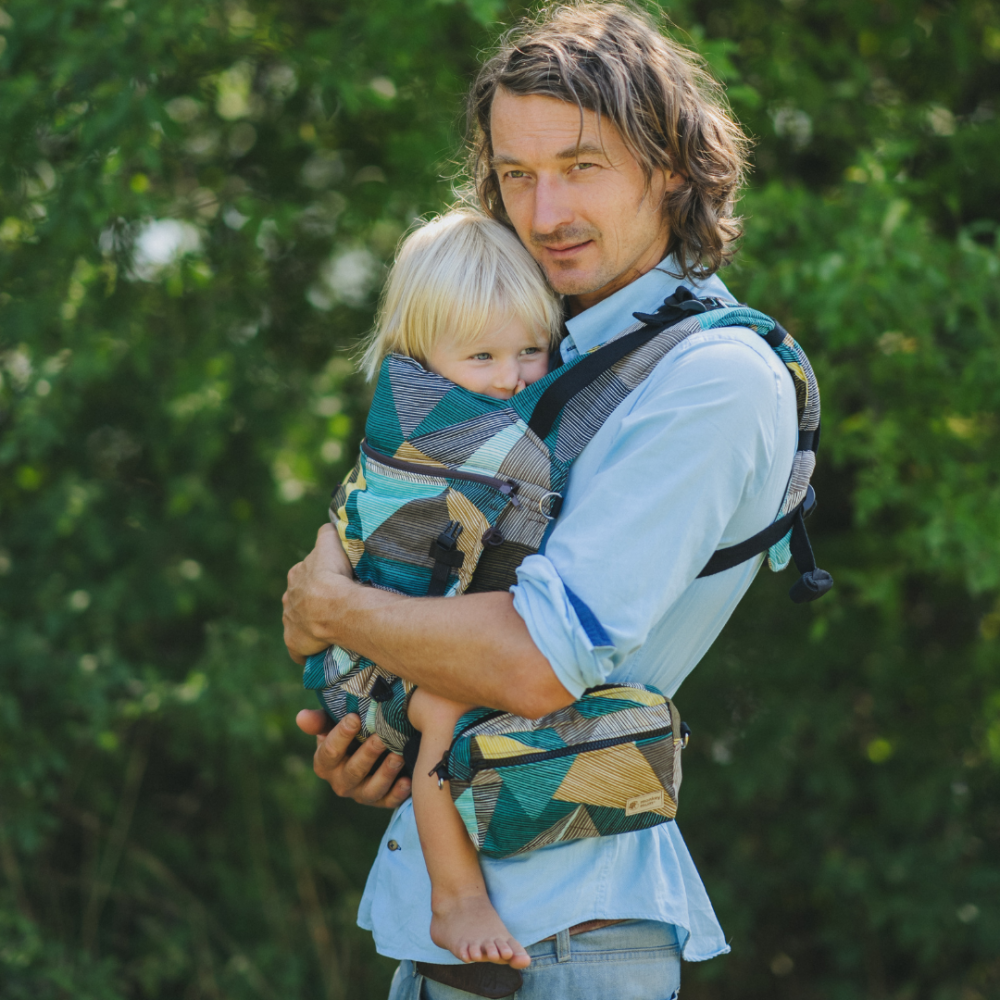
Carrying in a wrap or in a carrier is not a problem even with bigger children. Today there are many wraps on the market with a higher fabric weight that can carry even a 20 kg child. It is similar with carriers; they are usually labeled as toddler and can hold up to 30 kg. Both the wrap and the carrier weigh approximately 1 kg, are compact, and comfortable for both the child and the carrier wearer.
Why carry even bigger children (in a wrap or carrier)
- Free hands - when a child needs to be carried for any reason, both a wrap and a carrier allow us to have our hands free and still cook and clean, dance, go for a walk, work on the computer, in short, do anything we can think of without major limitations.
- Carrying for short stretches - when a child wants to walk on their own but cannot manage longer distances, then both a wrap (for example a ring sling) and a carrier (for example an onbuhimo) are suitable for carrying them for short stretches.
- Falling asleep - some children cannot fall asleep just like that in bed, and as soon as they are gently rocked in a wrap or carrier, they fall asleep in no time (if possible, the child can then be moved to bed for the rest of their sleep).
- On trips and hikes - a larger carrier is useful for hikes when the child cannot walk the whole way and a stroller cannot get through.
- During illness and pain (e.g. teething) - when children are in some discomfort, they sleep better and more peacefully close to us; at the same time, skin-to-skin carrying is possible, and thanks to the parent's body heat, the child's temperature can be reduced in case of fever.
- Fatigue - a carrier helps when the child is tired and their little legs hurt (on a trip or a longer walk). In addition, it is possible to be outdoors with the child all day, and when it is time for their afternoon nap, you simply put them on your back in a wrap/carrier and happily keep going.
- Easier travel around the city - public transport, stairs, shops with narrow aisles.
- Discreet breastfeeding - in a carrier, you can breastfeed discreetly and put the child to sleep at the same time without anyone noticing.
- Even carrying during pregnancy is not an obstacle - at first you can carry in the usual way on the belly, later on the back.
Even when a child is already bigger, even a two-year-old or three-year-old, they may still enjoy being carried, and we certainly do not spoil them by doing so. One day the time will come when they will no longer want to be carried and will generally not need us as much, so we can make use of the first few years of a child's life to give them closeness and help them discover the world from near us.

Write a comment
This site is protected by hCaptcha and the hCaptcha Privacy Policy and Terms of Service apply.