

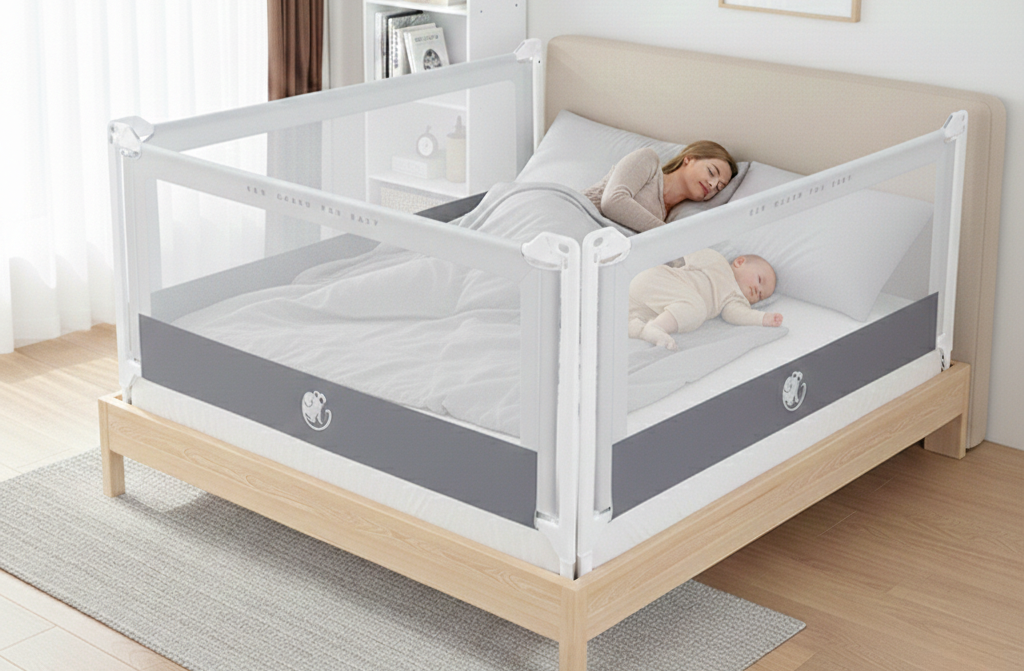


Why is the Popular line the most popular choice of Czech parents?
Why is this line called Popular?
Because it is among the best bed rails we offer — and at the same time remains an affordably priced choice.
The Popular line is one of the two best solutions in our offer.
It offers professional-level quality and reliability, but without an unnecessarily high price.
It is a smart choice for those who want a top-quality product and, at the same time, a sensible investment.
That is why this line has become a bestseller and the first choice of thousands of families who want to sleep peacefully and not have to deal with bed falls every night.
The End of Pillow Barricades: How One Simple Thing Changes the Night for the Whole Family

Every parent knows it:
- pillows piled around the child
- blankets on the edge of the bed
- constantly checking during the night
- waking up at every movement
And yet the concern remains:
"What if they fall?"
Bed rail solves this problem once and for all.
Creates a firm and stable edge of the bed that:
- protects the child from falling
- allows for calmer sleep
- reduces parents' stress
-
increases the feeling of safety during co-sleeping
The result?
More sleep.
Less stress.
A calmer night for everyone.
Who it is made for: The ideal family profile

The Popular line is ideal especially for parents who:
- practice co-sleeping
- have an active child who moves a lot in sleep
- want easy installation without drilling
- are looking for a reliable solution for every day
- are moving from a crib to a big bed
2. What exactly is the Popular bed rail, and what is its "magic"?

The technical heart of the bed rail: A construction that lasts for years
At first glance, a simple thing.
But inside, a well-thought-out construction.
The Popular bed rail is made of:
- durable iron frame
- breathable polyester mesh
- soft protective caps
- plastic clips
This combination ensures:
- stability
- safety
- long service life
- comfort for the child
The mesh is also sufficiently strong and breathable, so the child can breathe freely even when in contact with it.
Three-step safety lock: Safety vs. comfort
One of the key features is three-step safety lock.
It is designed so that:
- the child could not open it
- the parent opened it quickly with one hand
- prevented accidental opening
That is especially important at night, when you need to react quickly and without complications.
Safety without complexity.
Visual aspect: A design that does not disturb the interior
Modern children's furniture no longer has to look like a toy.
Popular bed rails have:
- modern color options in two shades – light gray and dark gray
- simple design that does not feel distracting
- clean lines that fit into most interiors
That is why they suit:
- for the parents' bedroom
- for a children's room
- for a modern interior
They are not obtrusive.
But they are functional.
3. When and where does the Popular bed rail not fit?

Bed types: Where it works best
The Popular barrier is designed primarily for classic frame beds.
For a safe and stable installation, the bed must have:
-
slatted base
or - solid board
These types of structures allow proper attachment of the barrier and securing with a safety strap under the mattress.
When this barrier may not be suitable (or requires a special procedure)
There are situations where use is possible, but limitations must be taken into account.
Adjustable slatted bases
The barrier can be used, but:
before every adjustment of the slatted base, the barrier must be removed.
The reason is simple — movement of the slatted base could disturb the stability of the structure or damage the barrier.
Beds with storage space.
For beds with a lifting slatted base, a similar rule applies.
If you need to open the storage space: it is necessary to disconnect or remove the barrier first.
Therefore, it is a good idea to consider how often you will use the storage space.
Bunk bed
The bed barrier can be used only for the lower bunk. It is not intended for use on the upper bunk of a bunk bed.
Box spring and frameless beds
The Popular barrier may also be suitable for:
- box spring beds
- frameless beds
- beds with an atypical construction
In these cases, we recommend contacting us before purchase so we can check compatibility with the specific type of bed together and ensure safe use of the barrier.
4. How are Popular barriers used in practice?

Lowering system: Easy access to the child
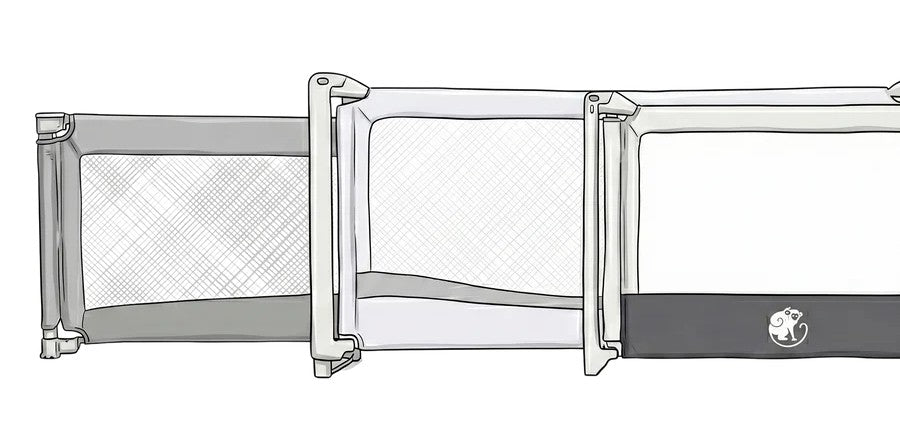
One of the most practical features is the option to lower the barrier down.
It works like this:
- press the opening mechanism on both sides of the side panel
- you lower the barrier down
- you get free access to the bed
You will appreciate this, for example:
- when putting the child to sleep
- during night feeding
- when getting out of bed
Co-sleeping: How to create a safe “nest”
A big advantage is the option to connect multiple pieces.
You can create:
- protection on one side - one barrier
- L shape - two barriers
- U shape - three barriers
- complete bed perimeter - four barriers
Care: What to do in case of an accident
The reality of parenting is simple:
accidents happen from time to time.
The good news is that maintaining the Popular barrier is designed to be as simple and quick as possible. Both the mesh and textile parts can be easily cleaned and used again.
How to clean the netting (sheet)
We recommend cleaning the sheet according to the instructions on the label, which is placed on each barrier.
General recommendations:
- hand washing is the most suitable
- you can also use the program “hand wash” or “delicate wash,” if your washing machine offers it.
- use a gentle detergent
This method helps preserve the strength of the material and the long service life of the sheet.
Drying the sheet
The sheet barrier cannot be dried in a dryer.
For proper drying, we recommend:
- leave the sheet let air dry in a vertical position
- dry at room temperature
- avoid direct heat sources (e.g. radiator)
Polyester mesh is designed to be durable and dry quickly, so the barrier can soon be ready for use again.
5. Installation guide: Anyone can do it

The good news is that installing the Popular barrier is not complicated, and most parents can manage it the first time without technical experience. The whole process usually takes about:
10 to 15 minutes
In the package you will find clear illustrated manual, which guides you through the individual steps from unpacking to first use. If you want to be sure in advance, you can also look at the instructional video, which is available directly on the product page on the website and on YouTube.
Just follow the steps one by one.
The only tool you will need is:
-
Phillips screwdriver
How the installation works in practice
- Unpack all the parts from the box and check that everything is complete.
- Assemble the basic structure from the individual rods.
- Using two screws, fasten the metal brackets in the side panels of the barrier
- Attach the fabric sheet (mesh) to the frame.
- Place the barrier on the bed slats or a solid board.
- Secure it with the safety strap under the mattress.
- Put the mattress back in place.
If you are installing multiple barriers side by sidethe individual parts are connected to each other using connectors.
In that case, you need to use another four screws to fasten the connectors, which ensure a firm connection of the entire assembly.
Done. The barrier is ready for use.
The eternal dilemma: Drill or not?
When choosing a bed barrier, parents often deal with one basic question:
choose a model that is drilled into the slats, or a model that is used without drilling?
It is not just about the mounting method.
It is mainly difference in the construction and manufacturing style of the barrier.
There are two basic types on the market.
Drill-free barriers: a modern and flexible solution
Drill-free barriers are designed so that they they are simply placed on the slats or a solid board and weighted down with the mattress. Stability is ensured by the construction, the safety strap, and the weight of the mattress.
Advantages of this solution:
- quick installation
- no changes to the bed
- easy removal option
- suitable for most households
This type includes, for example, the series:
- Popular
- Premium
This is the most common choice of parents today because it combines safety and ease of use.
Drilled barriers: a firm but less flexible solution
The second type is barriers that they are screwed directly into the bed slats.
These models have a different design principle — stability is ensured by mechanical fastening, not by the weight of the mattress. Some models on the market are designed exactly this way, and drilling is necessary with them.
Typical features:
- fixed permanent attachment
- less mobility
- more complicated assembly
- need to interfere with the bed slats
How to decide in practice
The general rule is simple:
It is not about whether you want to drill.
It depends on which type of barrier you choose.
If you are looking for a solution:
- for everyday use
- without altering the bed
- with easy removal
then a bed rail is more suitable without drilling.
If, on the other hand:
- you want a permanently fixed attachment
- you do not plan to remove the bed rail often
- you do not mind altering the bed structure
then model with drilling.
Height adjustment: The key to safety
The correct height is crucial.
Goal: no gap between the mattress and the bed rail.
The Popular bed rail allows height adjustment up to: 95 cm.
This provides sufficient protection even for older children.
6. Safety certification: No compromises

Standards and tests
Popular bed rails meet European safety standards.
For example:
CE (EN71)
This means that:
- have been tested
- meet safety requirements
- are suitable for children
Materials under the microscope
The materials used are:
- tested
- health-safe
- safe for children
Specifically:
- polyester fabric
- plastic connectors
- metal construction
Everything designed with an emphasis on safety and long-term use
7. How to choose the right length?

Measuring the bed: Most common mistakes
The most common problem is usually not the wrong product.
It is a poorly measured bed.
To choose the right bed rail length, you need to measure the inner bed frame — that is, the space into which the mattress is inserted.
This is the dimension that determines how long the bed rail will fit properly and work safely.
Typical measuring mistakes
We most often encounter these situations:
- the customer measures outer dimensions of the bed instead of the inner frame
- measures only the mattress, but does not verify the actual frame dimensions
- does not measure the bed at all and relies on an estimated size
- buys a bed rail based on the bed size name (for example, 180 cm) without checking the actual inner dimension
The result may be choosing the wrong bed rail length.
Correct measuring procedure
The process is simple and takes just a few minutes:
- Measure the inner length of the bed frame — that is, the space where the mattress is inserted
- Measure from one inner edge to the other
- Choose the matching bed rail length according to this measurement
Simple rule:
Always measure the bed frame, not its outer dimensions.
Typical lengths:
- 80 cm
- 90 cm
- 100 cm
- 120 cm
- 130 cm
- 140 cm
- 150 cm
- 160 cm
- 180 cm
- 190 cm
- 200 cm
Each option is designed for a specific bed size and family needs.
8. Final summary: Is Popular the right one for you?

Checklist![]() for a quick decision
for a quick decision
Answer these 5 questions:
- Do you want simple installation without drilling?
- Is your mattress between 10 and 30 cm high?
- Are you looking for a reliable everyday solution?
- Do you need protection for co-sleeping?
- Do you want a good price/performance ratio?
If you answered: YES to at least 4 questions then it is very likely that: the Popular series is the right choice for you.
9. Not sure which one to choose?

Each bed is a little different, and sometimes it is hard to choose the right bed rail just from the description. If you are not sure, send us a photo of your bed to informace@monkeymum.com – we will be happy to recommend the most suitable option.

Write a comment
This site is protected by hCaptcha and the hCaptcha Privacy Policy and Terms of Service apply.