


Getting children to sleep is a big topic for many parents. Some children only need to be put into their crib, have a music mobile turned on above them, get a pacifier in their mouth, be left alone, and they fall asleep on their own. But there are far more children who are different, who take longer, need more contact, and simply do not get along with the crib. What are the reasons why children do not want to sleep in the crib, and what can be done about it?
Possible reasons and how to deal with them
- Reflux - babies with reflux often prefer to sleep upright, when a parent holds them on their shoulder, and as soon as they are laid in the crib, they wake up immediately. Unfortunately, this position triggers reflux for them, which is uncomfortable. During the day, this can be managed by carrying them in a wrap/carrier. For nighttime sleep, it helps to adjust the angle of the crib so that the head is higher than the feet. But not too much, so the baby does not slide down in the crib. The mattress can be propped up with books or a special wedge.
- Neck spine problem - during birth, there may have been a blockage in the cervical spine, and babies then have trouble lying still on a flat surface; they are happiest in a parent’s arms or in a wrap/carrier. In this case, it is ideal to visit a physiotherapist or osteodynamist, or possibly craniosacral therapy, and remove the blockage.
- Separation anxiety - children around 8-12 months have so-called separation anxiety, when they cannot handle separation from their mother, whether during the day while awake or at bedtime. Separation anxiety can also appear later, between 1.5 and 2.5 years of age. During this period, you can try and practice only short separations, where the child knows you will come back (going to the toilet, to the next room, hide-and-seek, etc.). For sleep, it is advisable to stay with the child until they fall asleep; you can put them to sleep in a big bed and then carry them, or temporarily take them into your bed and sleep together.
- Negative emotions associated with the crib - a child may wake up at night, for example because of night terrors, or may have bad dreams and may not feel comfortable being alone in the crib. This is definitely helped by co-sleeping, either in a big bed or with the crib pushed up next to the big bed without one side attached.
- Teething - for children, it is more comfortable to sleep upright because their teeth hurt less. When teething, children most like to fall asleep in an adult’s arms with their head on the shoulder, in a wrap, or in a carrier. For teething, you can try various gels or homeopathic remedies, gum massage, cooling teethers, and more frequent breastfeeding. For nighttime sleep, co-sleeping can help, allowing the child to fall asleep faster even though they will wake more often.
Co-sleeping
If a child is not bothered by any physical problem that makes them not want to be put down in the crib, then the best solution for everyone is co-sleeping. It is the most natural thing, which we, as the only mammals, reject.
Many parents are afraid they will roll over onto their child, but thanks to parental instincts that will not happen. The first few nights may not be completely comfortable for you, because you will still be looking for a suitable sleeping position, but you will see that it will work for you together.
Co-sleeping has many benefits, such as more convenient nighttime breastfeeding, the child syncing with the mother’s breathing and not forgetting to breathe (SIDS prevention), and the mother usually not fully waking up and therefore getting better-quality sleep.
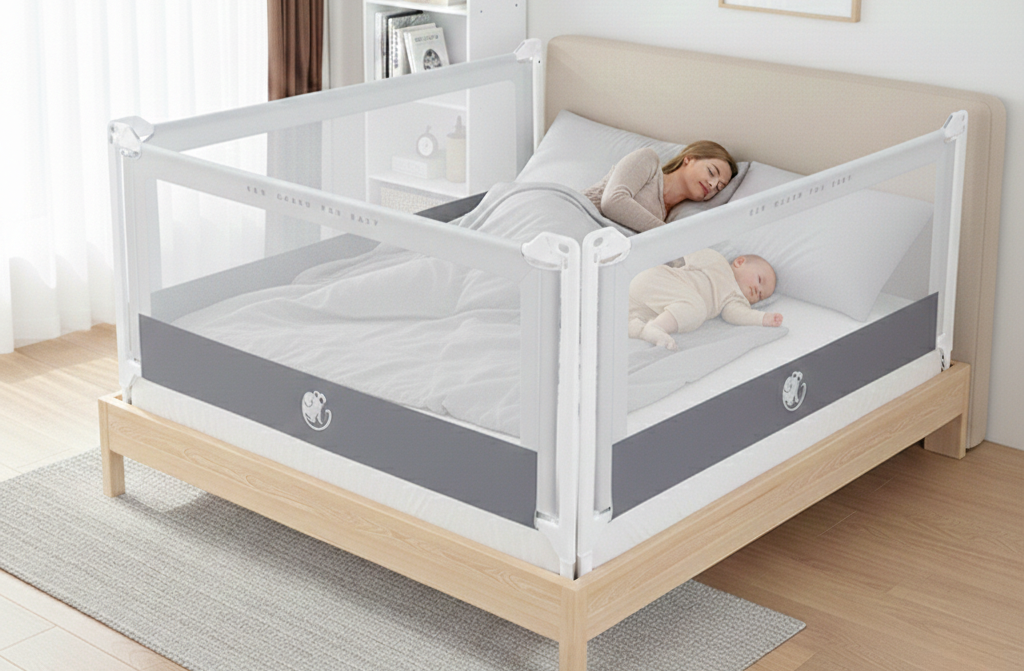
If co-sleeping appeals to you, get a larger bed so everyone can fit, and install bed rails on it, which will keep your child safe and allow you to sleep peacefully. Alternatively, push the crib without one side up against your bed, and whenever your child needs you, they can get to you quickly and without trouble.
When you do not want to sleep together in one bed
Some parents are not fans of co-sleeping, are light sleepers and need their own space, fear that they will never get the child out of their bed again (ironically, older children then come into their parents’ bed because they miss the contact), etc. So what can you try:
- Put the child to sleep in the crib even during the day so they can play there and feel safe there.
- Keep the crib in the bedroom or pushed up without one side to the double bed so the child does not feel alone. It is still co-sleeping, but it does not interfere with the space of the marital bed.
- For older children, you can buy a bigger bed and place it next to the double bed or leave it a little farther away so that the parent and child can reach each other and, if needed, hold hands.
The most important thing is to try the transition gradually, not to force it, and if it does not work, simply accept it, because that often helps the most and changes will begin to happen on their own. Children can sense when parents are tense, nervous, and do not want to let them go away from them.
Enjoy the time together; it may seem like it will never end, but believe that every child will mature into independence, and you will fondly remember the shared falling asleep and cuddling in bed.



Write a comment
This site is protected by hCaptcha and the hCaptcha Privacy Policy and Terms of Service apply.