

Psychomotor development through the eyes of a physiotherapist mom. Thank you @mamimi_fyzio for another part of our series.
The second trimester of the child (from the end of the third month to the end of the sixth month) is a period when the baby learns to explore the world with the help of its hand, its grasp develops, as do different ways of using that grasp. By the end of the third month, our model baby can perform a generalized grasp - that means that when a toy is offered from the midline, it brings its hands together, lifts its legs, and stuffs its hands and the toy into its mouth. Gradually, it starts to become aware of its little hand, the grasp reflex disappears, and the child begins to reach for toys of its own volition.
Fourth month
A four-month-old baby should be able to grasp a toy offered from the side, but the grasp does not yet have to be precise; the hand grasps the object from the little-finger side. It plays with its hands in front of the body and watches them; anything it grasps still immediately goes into its mouth. It begins to discover its body, touching its belly, genitals, and groin. On the stomach, it also tries to grasp; the original symmetrical support on the elbows becomes an asymmetrical position, from which another important milestone gradually develops - support on one elbow and the opposite knee. This position is very important for further development. It is here that the upper limbs are divided for the first time into a supporting and a grasping arm. It is at this age that the brain learns that it is possible to reach for a toy with both hands and that one can support oneself on both elbows and both knees. The basis for future crawling is already being formed here.
When should you pay attention?
- If my baby does not grasp a toy with one hand while lying on its back, does not play with its hands in front of its face, and does not touch its belly.
- The child is on its stomach with its legs in a “frog” position tucked behind the body. When grasping on the stomach, it lifts its legs, grasps with only one hand while keeping the other underneath itself, leans back a lot while on its stomach when grasping, and develops wrinkles at the back of the neck.
Fifth and sixth month
Five months is the period when the baby begins to form a sense of space. It can grasp an object with its hand from the midline, and gradually discovers that a toy can also be grasped across the midline, which is the basis for future rolling over. While lying on its back, it is able to touch its knees.
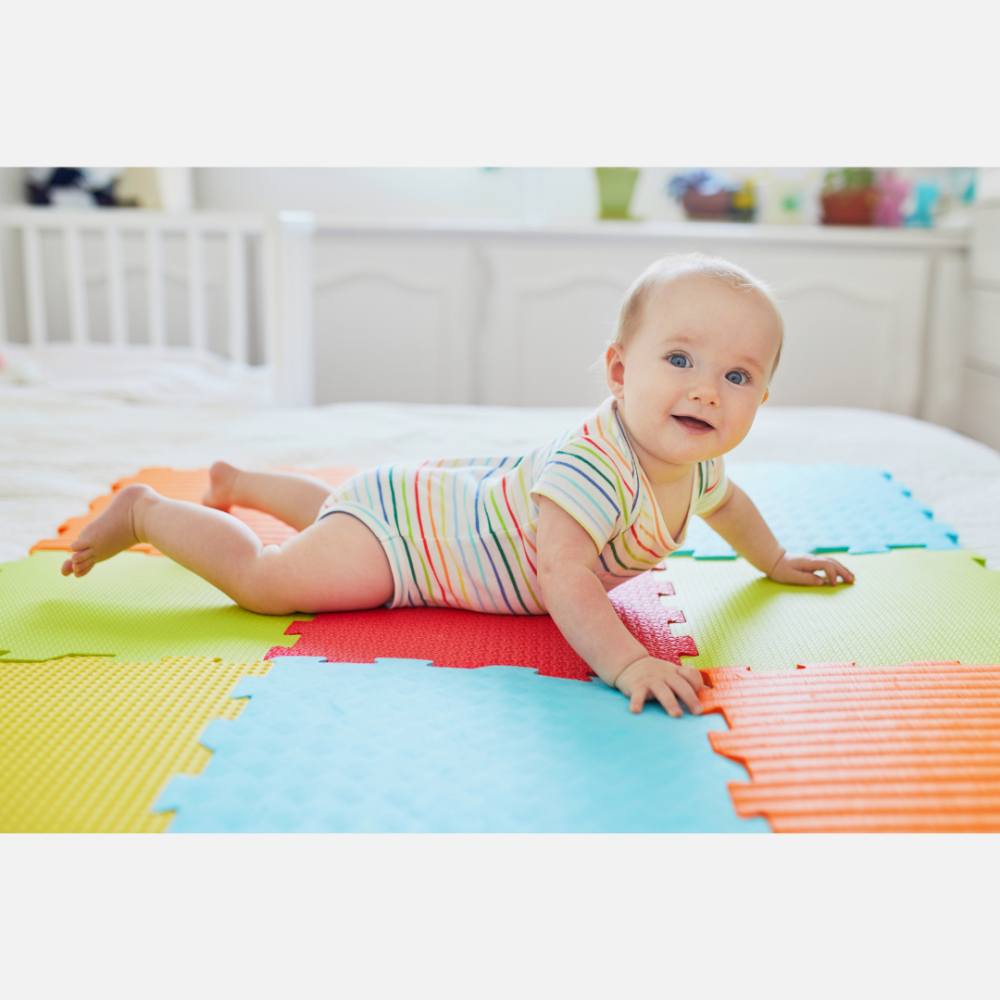
During the sixth month, rolling onto the stomach appears as well. Rolling onto the stomach is connected with grasping a toy across the midline, when the baby is able to follow the hand trying to grasp a toy across the midline, lifts its legs, pushes up on the lower arm, on which it props itself, and gradually, by pulling with the abdominal muscles, rolls over; the lower leg straightens during the roll until the child turns onto its stomach. I consider it important to point out that the correct roll is initiated by grasping, so the child goes after the hand.
When should you pay attention?
- The child rolls only to one side.
- It rolls with a pronounced backward bend.
- It does not use its hands for rolling.
A half-year-old baby spends only a minimal amount of time on its back; most babies prefer the position on their stomach. While lying on its back, it is able to pass a toy from one hand to the other, fully open its hand, and grasp an object from the thumb side as well. On its stomach, a six-month-old baby tries to have the widest possible view. It pushes itself up onto open palms, so-called into the “second floor,” which opens up space and prepares its “view” for moving forward. Sometimes at this age the baby pushes up onto all fours and bounces, but from such a push-up it still cannot crawl. Sometimes the “airplane” or “swimming” pattern appears, when the baby has both arms and legs lifted and its back arched. Rolling and interconnection of the hemispheres is also important for movement of the tongue from side to side, so at this age the baby is ready to move food around the oral cavity and ready for complementary foods.
When should you pay attention at six months?
- The baby supports itself in the “second floor” on closed fists.
- The support is asymmetrical or the body is curled up like a roll.
- If, in support on the palms, it seems too arched in the back.
- It does not touch its feet while lying on its back.
- The “airplane” pattern predominates over support on the palms.
And what does a baby do when it can already look around and see where all the things to grasp are? It develops the need to get to them… But more on that next time.

Write a comment
This site is protected by hCaptcha and the hCaptcha Privacy Policy and Terms of Service apply.