

Article author: Iveta Bartošová
Children are naturally curious and eager to learn new things from birth. As they gradually grow, they learn to control their bodies, first their gross motor skills (walking, hopscotch, riding a bike, etc.), and later also their fine motor skills (sticking on stickers, cutting paper, tying shoelaces, etc.). It’s great when, before starting preschool, they can manage to be independent with self-care, such as dressing, washing their hands, using the toilet or potty, drinking from a cup/glass, and using cutlery so they can eat by themselves. So how can you help your child become more independent?
Prepared environment
The ideal basis is the so-called prepared environment. The term comes from Montessori pedagogy and means that the environment in which the child moves about (most often at home) is prepared for them so that they can handle various tasks independently. For example, washing their hands (they have a step stool by the sink), getting their clothes from the wardrobe (they are stored at a height they can reach), or hanging their coat on a hook because it is positioned at a reachable height, and so on. In such an environment, the child feels good, can do many things on their own, and therefore is not frustrated by having to wait until you have time and free hands; nor do you need to forbid them anything or make them wait. In preschool, they’ll then manage with ease, because everything there is adapted for children.
“I can do it myself”
As soon as a child starts saying “I can do it myself,” it’s a great opportunity to let them do any activities they get excited about. Children are most interested in everything around the age of 18 months. Try not to correct the child, and if they are not doing something that is clearly dangerous or would make more of a mess than you can handle, then let them repeat the activity. Their goal is not to finish something, but to learn through repetition. So if they sweep crumbs off the floor and then dump them back there and sweep them again, they are mastering the activity. It’s therefore great if you let the child repeat according to their needs, and if they didn’t do the task the way you imagined, still praise them for their courage to learn new things. You’ll see that after some time they’ll be more confident in these activities and will truly help you with them. If you haven’t supported this stage of development in children, then before starting preschool they may boycott any attempt you make to encourage independence in self-care. It will then take longer before they start cooperating with you again.

Practice makes perfect
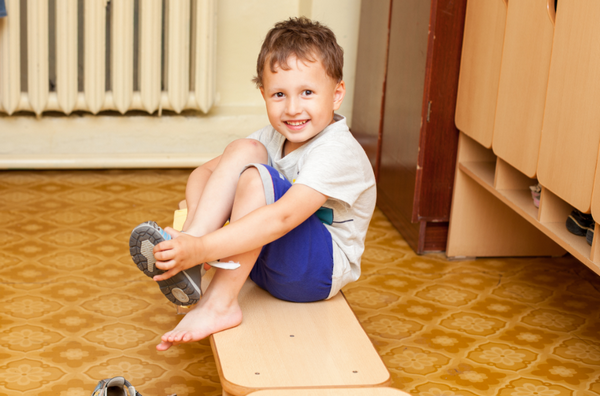
Even we adults can’t manage new things right away on the first try, and little children need repetition even more. So if you want your child to become more independent, for example in dressing, you need to give them opportunities every day to practice and improve. If they can put on a T-shirt, but it’s inside out, or if they put on a hat with the picture at the back, leave it be and praise them for managing it. Later, or the next day, there will be another opportunity to improve. When you do everything for the child, they may become frustrated that they can’t, for example, manage to eat by themselves at preschool, while the other children can.
Play so it’s not boring
Some children need everything to be turned into a game—dressing, tying shoelaces, combing hair, and putting on shoes. These activities are boring for them and they don’t want to deal with them at all, even though they are necessary. So you can play, for example, fashion show and try on different pieces from the wardrobe. When drinking from a cup, you can clink cups and say cheers; children absolutely love that. Or you can stick half of a picture into each shoe and show the child that when the shoes are placed next to each other and the full picture appears, the shoes are properly ready to be put on. Anything you can think of that the child enjoys can be used to develop independence.

Preschool can be motivating
More competitive children may be motivated by the preschool environment: at home they don’t want to do any independent activity, but when they see other children at preschool managing lots of things on their own, they want to be able to do it too. Suddenly they have huge motivation to show that they can do it without help as well. So once a child comes home from preschool saying they can now put on a shirt like Maruška, praise them—they just needed time to come to it on their own without pressure from a parent.
In short
From birth, children have the desire to learn, and it is up to you what suitable opportunities you give them for that. The ideal place for learning is a prepared environment in which the child feels safe and can do many things independently (for example washing their hands thanks to a stool, or hanging a coat on a hook that is at the child’s shoulder height). At the same time, it is very important to allow practice, because through repetition a child learns best what they need. Some children need learning in the form of play for more boring activities (dressing, combing hair, tying shoes), and here it is all up to your imagination, because you know your child best and can judge what will work for them. More competitive children will benefit from seeing other children at preschool managing to dress themselves, put on shoes, eat, and so on. It can be a great motivation for them to learn everything too and catch up with the others.
How was it for you with becoming independent? Do you have more of a little rebel at home, or a curious child?

Write a comment
This site is protected by hCaptcha and the hCaptcha Privacy Policy and Terms of Service apply.