

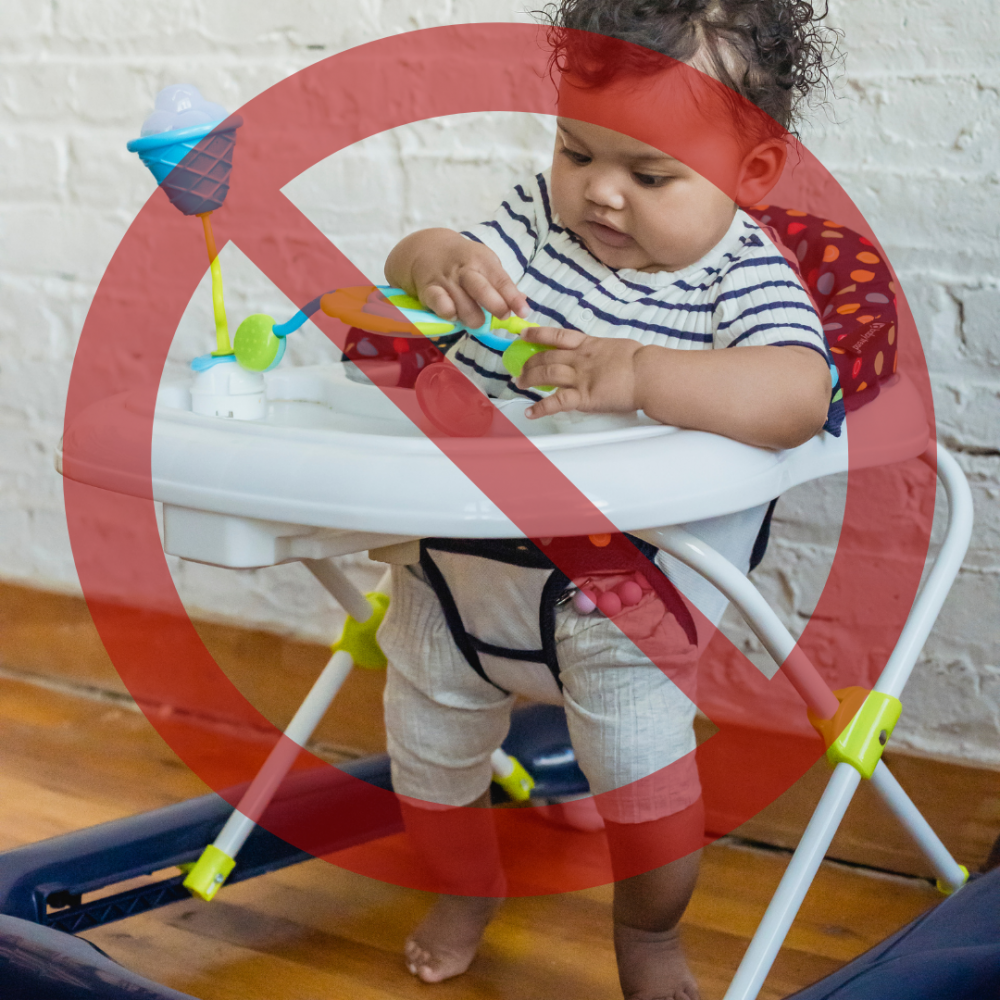
There are countless walkers on our market, and many parents unfortunately do not even stop to consider that they may do their little one more harm than help with those first steps. Why do we not recommend walkers as a suitable aid for children?
What is a walker?
It is an aid that, according to manufacturers, should help a child with walking. It should teach them to walk, and even earlier than without a walker. Today there are also so-called multifunctional walkers on the market. So besides “supporting” walking, they can also be used as high chairs or as activity trays with various activities. Marketing-wise, it looks like a great thing, but in the end the child will not know what to do with this thing and it will be confusing for them. The ideal is to always have an aid for a specific activity, so the child can practice and focus on just that one task.
So why not use a walker?
Quite simply because it will not help the child walk earlier. For a child to manage independent walking, all the necessary muscles in the body need to be strengthened. And a walker certainly does not help with that. On the contrary, the child does not engage these muscles in it and overloads others. There is also a risk that the child will have problems with hip development, because the position of the legs in a walker is not correct.
Your parents or friends may argue that they used a walker and that it had no bad effect on their body. Unfortunately, this may only become apparent years later, and no one will blame the walker anymore. Problems such as back pain, migraines, or even flat feet may appear.
What should be used instead of a walker?
Nothing. The child will simply figure it out on their own. Even being guided by the hands should not happen too often, because it will not speed up development. From birth, babies learn by imitation and are naturally curious, so they want to make progress and discover new things, new movements, and learn to do what their parents do. They start by lifting their head, the first straightening up, the second straightening up, and so on, until they manage to stand on both feet. Then they want to reach objects around them, so they begin to walk around furniture. In doing so, they strengthen all the necessary muscles again, and once they feel confident, they set off without support. For each child, this takes a different amount of time, and we should not rush them. Everything has its time: some children start walking independently before their first birthday, others do not dare until they are a year and a half old. Both are fine.
You may envy the neighbor next door that her Pepík has been walking for ages and your Anička is barely crawling on all fours. But if Anička is going through psychomotor development correctly and gradually, then that is fine and she needs more time to stand up and start taking her first steps. It is possible that Pepík will not be speaking even at three years old, while Anička will already be running around and reciting nursery rhymes on her own.
So do not worry too much about it and give it time. And if someone offers you a walker, whether as a gift or because they want to pass it on to you after their own children, politely decline with a smile. And if you do happen to have a walker, then pass it on to someone else.


Write a comment
This site is protected by hCaptcha and the hCaptcha Privacy Policy and Terms of Service apply.