

Vojta Method - scary or helpful?
The Vojta method, or “Vojtovka,” is a method that is more than well known in Czech settings, widely used and proven over many years. It is a reflex exercise, most often used with infants. It has both supporters and critics. Let’s answer together the most pressing questions that come up around it and try to take a little “look under the hood” of this technique.
What is it? How does it actually work?
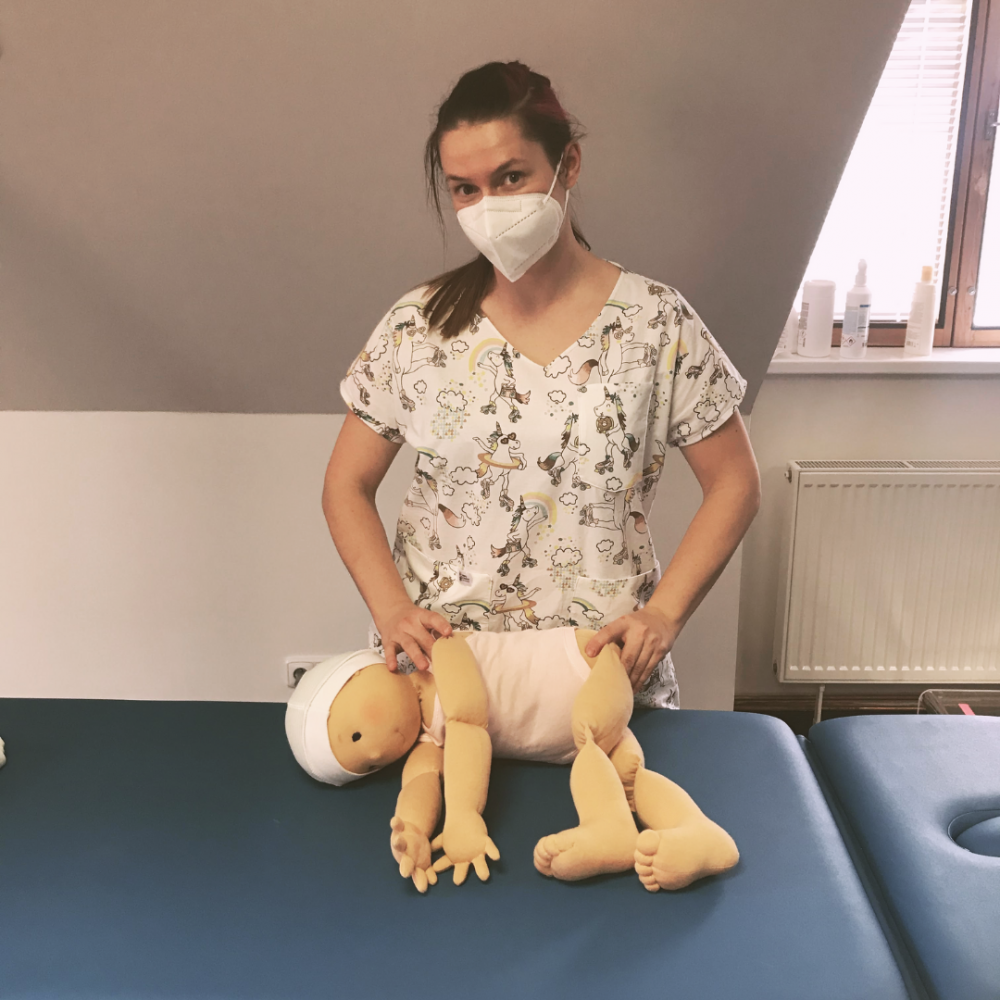
I’d like to explain a bit of the history of this method - back to its origins. Professor Vojta noticed at the time (quite by chance, in fact) that when pressure was applied to the shoulders of one neurologically affected child, its knees loosened and it fell down. And because he was a very inquisitive man, he began to study these movement connections and patterns in depth. Empirically, he tested how the nerve pathways of neurologically affected children respond when he lifts their head, bends their legs, or presses a pressure point. In this way, he found that there are points on the body that, when the body is placed in a certain position, always trigger the same movements. And Vojta's method is based on these observations. Very simply put, we can say that we are able to provoke precisely described movement from described positions by stimulating reflex zones - in short, we can persuade the body to perform the movement we need, even if the brain cannot make that movement (or motor program), or does not use it. When is the Vojta method indicated? Should all infants be treated with it? The Vojta method is primarily used in children who are diagnosed with some degree of the clinical condition known as Central Coordination Disorder - CKP. Diagnosis is based on a comprehensive neurological examination by a neurologist or physiotherapist. The Vojta method is indicated for CKP grades 3 and 4. My child was not diagnosed with CKP, and yet we are still doing “Vojtovka.” Is that wrong? Children with CKP are not the only group for whom Vojtovka is used. Much more often
I use the Vojta method with younger children. The less mature their nervous system is, the more effective the Vojta method is, the earlier the problem is treated, and the shorter the need for exercise, because the movement deficit does not have time to become fixed and will continue to develop normally. This category also includes premature babies - they are automatically at risk of suboptimal development, and therefore may be indicated for “Vojtovka” even without any diagnosis. The Vojta method is also used based on diagnosis when a child is “movement-poor,” would like to perform the movement in question, but its body does not allow it for some reason. The Vojta method can enrich movement variability with the necessary movement pattern and thereby allow further development.
We started doing Vojtovka, how long will we be doing it?
No one can answer this question for you - and sometimes not even your therapist. There are children who exercise for several weeks, and children who have to exercise for several months. Some are never completely “released” from therapy. In general, it depends on the child’s diagnosis, the reason you are exercising, and the severity of the impairment.
In general, it is easier to work with a baby who is tiny and has a very immature nervous system than with a toddler who already has fixed movement patterns and great strength. My child cries during Vojtovka - is that necessary? Does it hurt? With the Vojta method, we force the child to perform a movement that its body cannot create on its own. I usually tell parents that they would cry at me too if I forced them to do thirty burpees right now. And a baby cannot otherwise tell us that it doesn’t like this “gym.” The intensity of the exercise is set individually - from very gentle stimulation for babies with reflux and premature infants, all the way to a “real workout” for an eight-month-old toddler.
It is always necessary to assess whether it is the “lesser evil” for the child to cry during therapy 4 times a day, or to be frustrated for most of the day because it cannot perform the movement it wants to do, but its body prevents it from doing so. In centrally healthy children (without neurological impairment)
properly guided Vojta therapy can help very quickly and can turn even screaming and unhappy babies into content ones again.
Are there other approaches besides Vojtovka? Why Vojtovka specifically and not something else?
In its homeland, Vojta is a very widespread method and, I dare say, also quite often overused. It should always be indicated after a thorough examination, and the parent doing the exercises should be given proper support and must always understand why we are helping the baby with Vojtovka, how we will do it, and what we are trying to achieve. It is an extremely demanding method for both parent and child, but in some respects it is truly an irreplaceable miracle. It is, in fact, the only method that gives us direct access to the child’s central nervous
system and directly tells the brain how it should move. And unfortunately, this cannot yet be replaced by any other approach.
If a child has a smaller problem, it is not usually necessary to use the Vojta method, and we can also help them with methods from ACT, the Bobath concept, or other methods. Ideally, methods should be combined and therapy tailored to the child, selecting from different concepts exactly what they need. Always make sure your therapist has the appropriate training.
A few words in closing:
I cannot end without adding a personal experience with the Vojta method from a parent’s perspective. My son was born with postural asymmetry, and I myself suddenly went from the role of therapist to the role of a mother doing the exercises. I could see how he could not effectively support himself on one arm and how much that annoyed him. He had always been a bit “borderline,” and even with proper handling he simply did not develop symmetrically, and he needed help from Vojtovka. Until the period of independent crawling, he went through four intensive several-week “Vojta interventions,” during which I always helped him get past the movement block and then “let him live” again. During periods of intensive exercise, it was demanding mainly organizationally - suddenly the day revolved around exercise, the child can’t be left with just anyone, and for visits only with friends who understand that I’ll borrow a table and do therapy with a screaming child at their place. A baby gets used to it, knows that as soon as I clap, the exercise is done and it can go play again, and quickly calms down. I can see that he is able to reach his goal without frustration - and that is worth all the effort and inconvenience.



Write a comment
This site is protected by hCaptcha and the hCaptcha Privacy Policy and Terms of Service apply.