

Psychomotor development, first part, or from mom’s belly to grasping.
When a baby is born, it is a huge change for them. The environment in the womb was much more favorable for them than the big world outside. In the dimness, with muffled sounds from outside and gravity lightened by a large amount of amniotic fluid, they were able to do many things that they then lose in the “big world” outside the womb. Did you know, for example, that some babies suck their thumb in the belly, or squeeze the umbilical cord with their little hand? Birth is just as demanding for the baby as it is for the mother herself. The baby is an active participant in labor, moving, wriggling, and responding to external stimuli in order to get out. So it is a shared effort. Birth makes the situation much more complicated for the baby. Suddenly it is in gravity, surrounded by lots of space, with unfiltered light and sounds, and it has to breathe, eat, and pass stool, which it did not have to do in the womb. At first, these tasks take up all of its energy.
So what does a baby look like up to four weeks old, and what can it do?
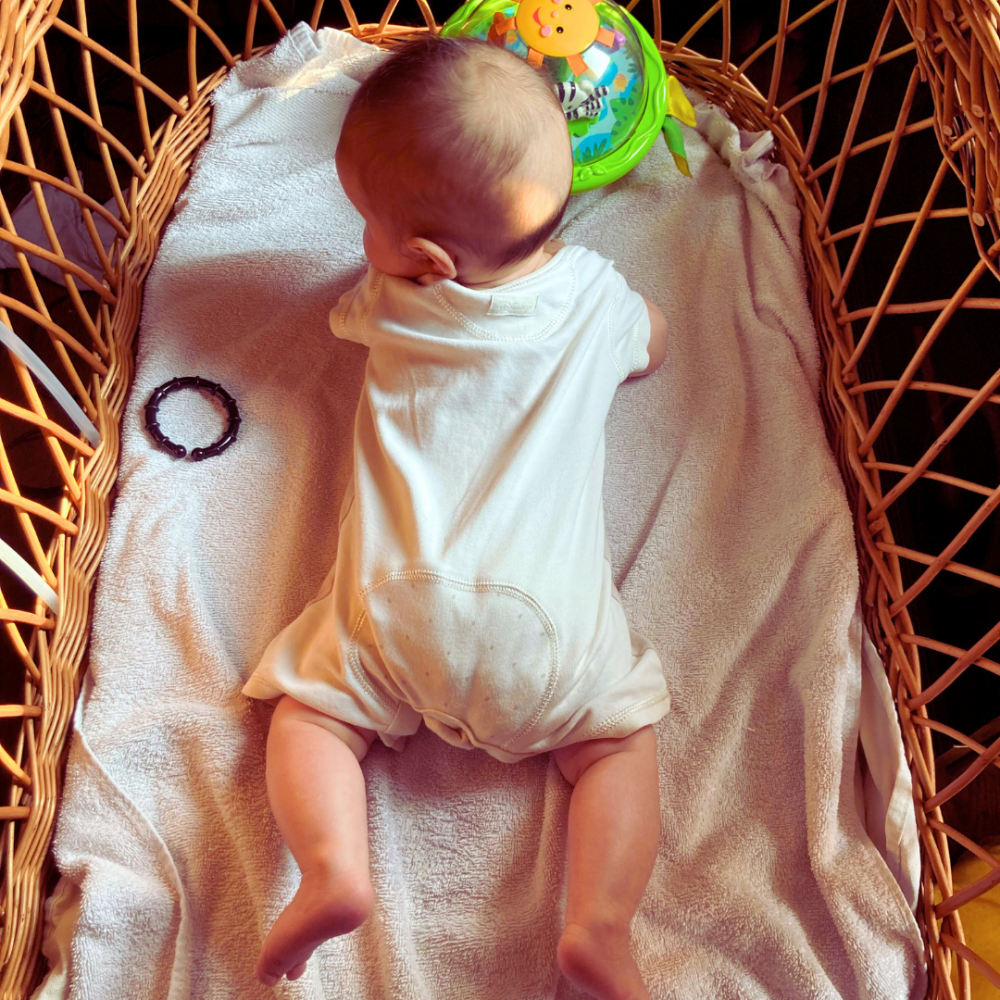
If the baby is not sleeping, it is always moving. The movements are cyclical and not purposeful in any way; the baby is basically a little lizard. It sleeps a lot. When we place the baby on its back, it may be asymmetrical, moving its whole body, and it should be able to turn its head to both sides toward the light. In the prone position, its little legs and arms are tucked in close to the body, and it can switch which side its head is turned to.
When should you pay attention?
- Always with premature babies
- If the baby has a noticeably crooked head from the womb
- The baby cannot turn its head all the way to one side
- I see a large diastasis or an umbilical hernia
What should you do with a newborn?
Cuddle, snuggle, and get breastfeeding going. Position the baby on its sides, back, and tummy. Learn to carry, change, and dress the baby properly. Gradually the baby straightens up and loosens its legs, which it extends behind itself. By four weeks, it should be able to lift its head for a moment, and it gradually works toward a major developmental milestone called optical fixation. Optical fixation is the engine of further development, because vision is one of the most used senses in humans. It means that the baby has developed far enough to be able to hold its head still enough to follow the object of interest with its eyes. This develops around the sixth week of age. This period is also associated with another adorable skill. If the baby sees a face, it will usually smile at it. At this age (6 weeks), it is also appropriate to have the baby’s first examination in terms of psychomotor development if you have any concerns.
What should a baby like this be able to do after the six-week postpartum period?
- On its back and on its tummy, it lies stably and does not topple over anywhere
- When I place the baby on its back, it can look at me from the middle, kicks its legs,
turns its head to both sides, and its body is not curled up - On its tummy, the baby can hold its head up for a short time and can look to both
sides
What can I do with the baby after the six-week postpartum period?
I offer high-contrast toys with large surfaces to look at; I can move them around and motivate the baby to turn its head from side to side. On the tummy, I offer a high-contrast accordion book or cards placed in front of the baby or to the sides. Now is the right time to add some variety and bring out the play gym.
And what comes next?
The entire development of the first trimester is rounded off by the skills of the third month, which lead the baby to have an overview of the situation around it, orient itself in its immediate surroundings, and become aware of the existence of toys and objects. For now, the main cognitive and tactile tool is the mouth. It still cannot purposefully grasp a toy and explore it with its hands. So when I offer a baby lying on its back a toy from the middle, it automatically brings its hands together, puts them in its mouth, and lifts its legs. Three-month-old babies like to explore different fabric textures this way, squishing them against their face and mouthing them. For the development of touch, it is extremely important that the baby puts both hands in its mouth. Therefore, when awake, it should not have a pacifier in its mouth at all, unless it urgently needs to be soothed. In addition, the baby needs to get to know its vocal cords and comments on everything with cooing. On its tummy, the baby has a good view, rests on its forearms, and turns its head from side to side.
For the sake of clarity, I’ll summarize in points what a three-month-old baby can do:
- On its back, it keeps its hands and feet lifted above the surface, brings its hands together, and puts them in its mouth
- On its tummy, it supports itself symmetrically on both forearms in front of the body, turns its head to both sides, and
looks around
What should you do with a three-month-old baby?
The play gym and toys hung at chest level are still very much in fashion. I do not stop it from exploring surfaces with its mouth; I can offer comfort toys, crinkly books, or a diaper under supervision. The baby becomes more and more aware of its hands, and it is precisely through this connection that it mentally moves into the second trimester. This is the period when it wants to grasp. But more on that next time…


Write a comment
This site is protected by hCaptcha and the hCaptcha Privacy Policy and Terms of Service apply.