

Psychomotor development in the third trimester
The third trimester is not easy to write about, because in a baby’s development it is one of the wildest periods of development. It discovers space and can move itself around. In the third trimester, we move away a bit from tables and the month-by-month view of development, because the baby discovers individual skills not in a tabular order, but according to what it is better prepared for and what interests it more at the moment. We now have a baby in the second upright position. It is more than half a year old, can look around farther, and is beginning to discover the existence of space. It starts pivoting - it steps forward with one foot and turns to the side so it can move around its own axis toward a toy. It should be able to do this skill to both sides. In the third trimester, three major developmental milestones should appear - and we will look at them a little more closely.
Side sitting
Side sitting precedes free sitting, and its presence in development is one of the fundamental building blocks for crawling. Side sitting is preceded by a coordinated roll onto the tummy. By coordinated we mean a roll that the child can stop during the movement and reach, for example, for a toy that is above them. First, side sitting with support on the elbow appears; later the child pushes up into a high side sitting position with support on the palm. Side sitting is a prerequisite for crawling, because it clearly determines which limb will be in support and which will step forward.
When should you pay attention?
- The baby does side sitting only to one side;
- the baby cannot push up onto the palm and remains in side sitting with support on the elbow;
- in side sitting it is unstable and falls.
Crawling
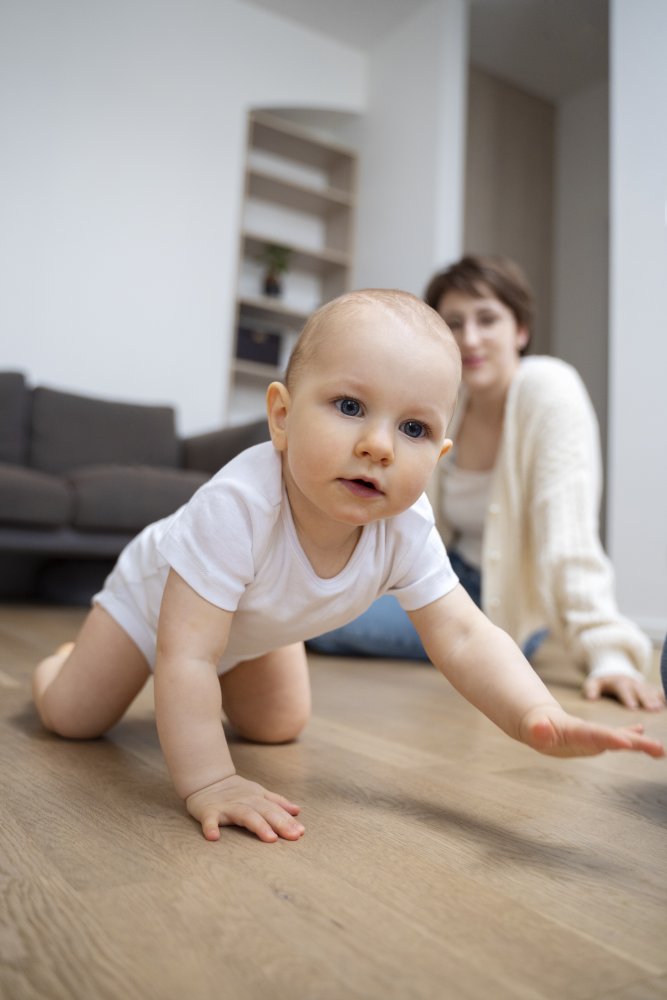
Whole essays could be written about crawling. It is an important developmental milestone, especially because it is a symmetrical movement similar to walking, coordinating the alternating movement of the upper and lower limbs. Crawling children strengthen the spinal stabilizing system and practice the muscle coordination needed for future walking. Proper crawling looks like this: the child is supported on the palms and knees and alternates opposite limbs. The legs are loosely placed behind them. From the back, the movements of the hips and shoulders on both sides should be symmetrical.
And what about creeping - does that not belong in development?
I like to speak of creeping, with a bit of exaggeration, as a developmental pattern of floating floors. These days it appears in children more often and, if it is symmetrical, it does not fundamentally harm development; however, it does not motivate the baby to lift itself up and thereby strengthen the limbs and tummy. Sliding along a smooth floor without resistance is, after all, the easier path. Sometimes so-called seal creeping appears, which means the child pulls itself forward on its tummy with its hands while the legs lie loosely behind it. Babies usually leave this pattern once they find a more efficient way of moving. Asymmetrical creeping is then a big warning sign. It does not appear out of nowhere; it is always the result of some previous asymmetry in the baby. If forward movement is perceived by the baby’s brain as walking practice, then asymmetrical creeping is forward movement that trains asymmetrical walking. In the future, such patterns could simply result in the child walking asymmetrically - one hip turning more inward, the other outward, one leg being significantly better in support, as well as one arm. Asymmetrical creeping needs to be addressed as soon as it appears, because the child has no motivation to get rid of it on its own - its goal is not symmetrical movement, but trying to get to the toy. And infants do not care how that happens.
Standing
Do you know when a child is ready to discover space? In the adorable period when they throw things off elevated places such as a stroller or high chair and watch with fascination as they fall down. We cannot be angry with a child for this behavior, because they are simply learning the depth of space so they can be ready to get into standing. The first standing position is usually unsteady, and it is not uncommon for the baby to crawl to a suitable support and pull itself up to stand by using its hands. The first standing position often does not include stepping forward, and even the little feet often end up placed in all sorts of ways. Do not panic and give the child time. During the third trimester, it should be able to discover stepping forward and stand on the soles of the feet.
When should you pay attention?
- If the baby stands up with only one foot stepping forward and cannot do it on the other side as well.
- If improper positioning of the feet persists (on the top of the foot, turned too far outward…).
- If the baby falls backward from standing “flat” onto its back.
A few words about skills that appear in the third trimester, but are not the main focus of physiotherapy:
Rolling onto the back
Rolling onto the back appears much later than rolling onto the tummy. First, it is a much more demanding movement in terms of coordination, but it also requires certain cognitive and coordination abilities, as well as courage, from the child. The child must be aware that space exists behind them. They must be sure that they can stop the roll at any time if something unexpected appears in the space behind them, and last but not least, they must not be afraid to enter the unknown (unseen) space. And that takes many cautious children a while.
Independent free sitting
The baby gets into a sitting position from side sitting by shifting its center of gravity and releasing the other upper limb. By the time the child sits up independently, they usually already have sufficient trunk training from crawling to be able to sit upright without a rounded back. We do not sit the child up before they sit up on their own and for longer than they can sit on their own of their own free will, or than is absolutely necessary.
That’s a lot, right? And the child is supposed to manage all of that between 7 and 9 months - that’s a lot of work! And independent walking is still far away. And that is exactly what I’ll write about next time.


Write a comment
This site is protected by hCaptcha and the hCaptcha Privacy Policy and Terms of Service apply.