

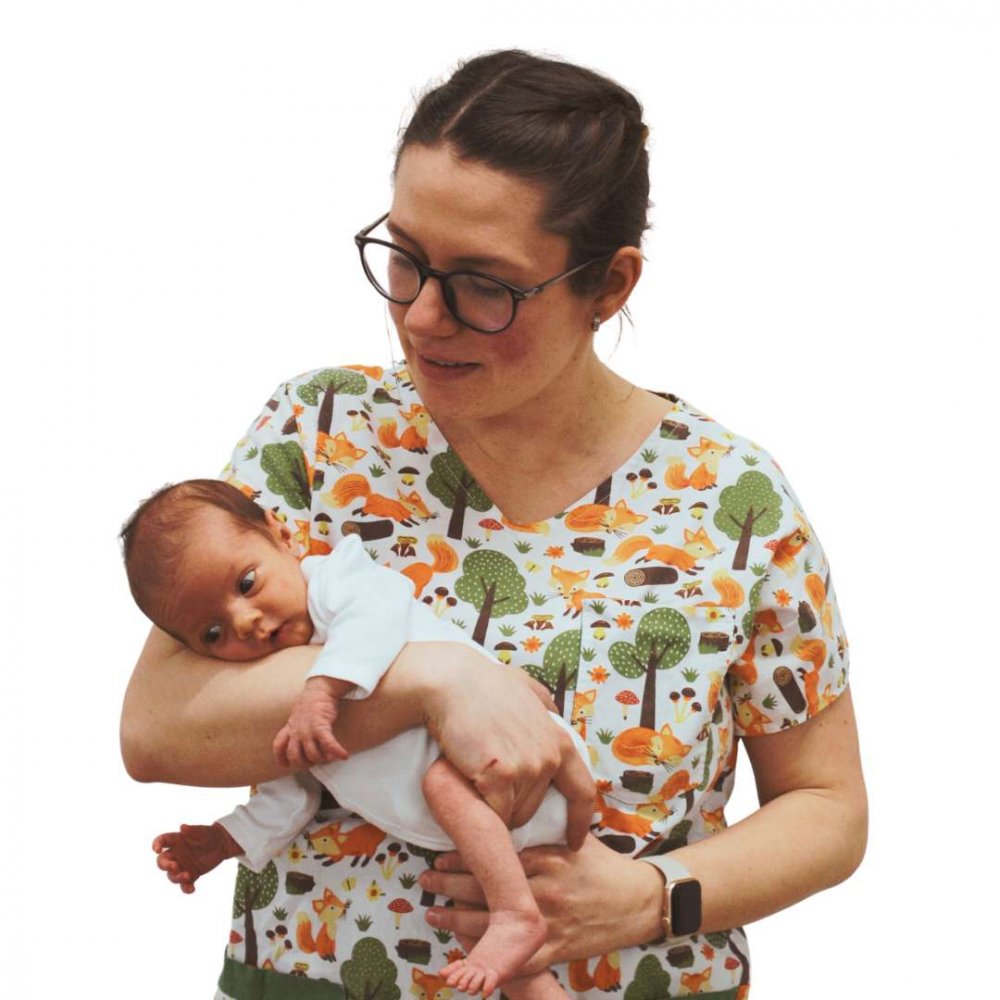
Recently we reached out to this amazing woman - a physiotherapist and a mom. Thanks to her, we’ll be preparing a short series for you about physiotherapy for babies and mothers. You can follow her on Instagram @mamimi_fyzio.
1. Could you introduce yourself a little - who are you and what do you do?
My name is Edita Knotková and I am a pediatric and women’s physiotherapist, currently on
maternity leave. In my practice I mainly work with babies and younger children, but
working with them led me to work with mothers as well, because they often neglect themselves and
don’t have time for themselves. That’s why it seemed ideal to me to tackle it, so to speak, “in one go” and
give the child’s therapy tips to the mother as well, or take both of them at once. During my maternity leave
I would like to focus mainly on workshops and education in my field.
2. Your favorite food, music, and how do you relax?
I like sushi the most. As for music, I have pretty bad taste, so I
listen to everything - from powermetal to Korean pop. I relax with anything that’s
outdoors. I’m glad the nice weather is here, because I’m capable of spending the whole day
driving around with a stroller.
3. What is the work of a pediatric and women’s physiotherapist like?
First and foremost, beautiful. I have always loved children, and completing the “Vojta method” course was my
dream come true. It’s wonderful to watch the progress babies make over the course of
therapy, but it’s also demanding work. Both because of the responsibility toward babies and
emotionally - some children cry during therapy, and I have to weigh things very carefully so that
the therapy I choose is as beneficial as possible for them and so that the family’s routine is, if possible,
disrupted as little as possible. In any case, the therapist needs to be just the right amount
gentle and strict, and it requires a great deal of empathy. Definitely not every baby
with a movement problem has to do Vojta therapy. And that’s the hard part - fine-tuning the exercise program for
a specific pair - most often the mother and child.
4. Can you introduce us to current trends in baby and mother physiotherapy?
The biggest trend I see is interest in information. Parents are paying a lot of attention to healthy
footwear, and barefoot shoes are in vogue. Interest in ergonomics at work, when sitting, and in carrying children has increased - and that includes both the correct positioning of the child and the correct posture
of the person carrying them.
Mothers are preparing for childbirth better than, for example, our mothers’ generation did.
They know that pregnancy is meant to be lived, not survived, and that it shouldn’t hurt. Before
birth and after it, they work on themselves - and that’s how it should be. If only every woman could properly
perceive and carry her body and her child. Both in the belly and in her arms.
5. Do you see your work differently now that you’re a mom?
Not really. My baby was born with positional asymmetry of the neck and head, so I
immediately started working gently to correct it. My child is an example of how, when
a problem is caught in time, only small routine adjustments are needed and the baby will
straighten itself out.
I was glad myself that I had a lot of information about how to work with my body so it wouldn’t hurt… And that I prepared for childbirth so well that everything went
smoothly and without intervention. The body is slowly returning to its previous function, and I would honestly wish everyone
to have everything as easy as I do. How much of that is due to my profession and
how much to luck, we’ll probably never know :)
Thank you very much for the interview, and we look forward to more interesting posts.


Write a comment
This site is protected by hCaptcha and the hCaptcha Privacy Policy and Terms of Service apply.