



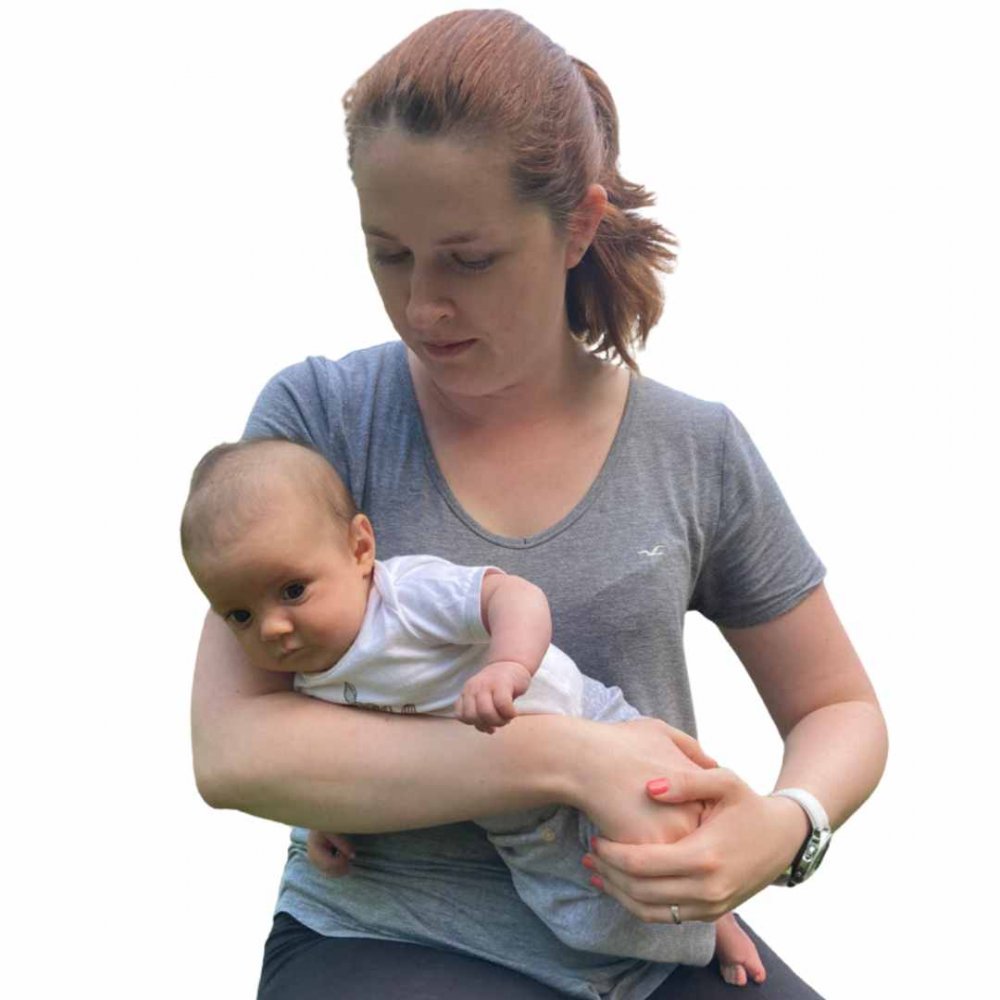
Handling. A topic repeated a thousand times on mummy websites and the social media accounts of physiotherapists and various movement instructors. But what is it? Where did it come from? What is it good for? Let’s look at this topic together in a bit more detail.
The term handling comes from the English verb “to handle,” which could be translated in two ways — and I personally like both. Both the meaning “to manage” and the one closer to us, “to manipulate” something. The term itself comes from the Bobath concept, developed by the Bobaths in the 1940s originally for neurological patients. In babies, the Swiss doctor Elizabeth König and the English physiotherapist Mary Quinton began working with this method.
What is handling?
Handling is a term that includes all handling of a baby, all stimulation through the environment, sounds, and light, and its goal is to support the baby so that it can perform movement correctly. As therapists, we understand handling as a holistic approach to the baby; we use it 24 hours a day, during dressing, undressing, and any lifting or other handling of the baby. Such an approach is then hard to compare with exercise, which we think of as a workout session. Handling uses the baby’s reactions to external stimuli. We observe how the baby moves in relation to the environment and how it responds to it. We deliberately choose touches and contacts so that the baby can perform the given movement according to its age. The baby experiences the movement supported by us, receives a reward (for example, it grasps a toy and puts it in its mouth), and by gradually reducing our input into its movement pattern, it learns to perform the movement without help as well.
Is handling for all children?
In general, handling and stimulation of a baby can only be advised for healthy children whose psychomotor development is without deviations. In children where we are already dealing with some deviation from the norm, it is necessary to assess therapeutically what is missing in the given movement and how to address the problem. Just as different children have different problems, they also have different temperaments. An approach that suits one may not suit another. In any case, it is necessary to look for and find what the baby responds to correctly.
When should you start paying attention to handling?
Handling a baby should be part of basic early parenting knowledge, because a child’s nervous system is very adaptable and improper handling can create a movement problem even in a healthy baby. By inappropriately overloading the musculoskeletal system, for example through unsuitable or one-sided carrying, the baby will get used to the position and transfer the learned muscle activation into other movement too, for example on the floor. This means that if a mother is right-handed, she should learn to carry the baby on her right arm as well and regularly alternate both sides.
What should you take away from this?
Every parent does not have to be an expert in motor development, nor is that possible, but it should be generally understood how to approach a baby at different ages. We lift a newborn differently than a one-year-old child. Even the support of the head, so common in our countries, is not an absolute dogma if we lift the baby facing downward. In that way, it learns to resist gravity in a way that is safe for it. To discuss in detail the individual stages of a child’s psychomotor development, an entire book would be needed. Fortunately, such publications already exist on our market, and various physiotherapy profiles and social media pages also provide guides. Always make sure, however, that the person whose advice you are following has sufficient training to provide such advice. And if you are unsure, seek out a pediatric physiotherapist. It is better to consult about a problem-free child than to deal with a child with a problem. Physiotherapists are not a punishment; nobody wants to harm your baby with exercise. We are here to help you.



Write a comment
This site is protected by hCaptcha and the hCaptcha Privacy Policy and Terms of Service apply.